
23 KiB
Example 1.1.1
Page 24
Use variables to rewrite the following sentences more formally.
a. Are there numbers with the property that the sum of their squares equals the square of their sum?
b. Given any real number, its square is nonnegative.
Solution
a. Are there numbers a and b with the property that a^2 + b^2 = (a + b)^2?
Or: Are there numbers a and b such that a^2 + b^2 = (a + b)^2?
Or: Do there exist any numbers a and b such that a^2 + b^2 = (a + b)^2?
b. Given any real number r, r^2 is nonnegative.
Or: For any real number r, r^2 \geq 0.
Or: For every real number r, r^2 \geq 0.
Example 1.1.2
Page 26
Fill in the blanks to rewrite the following statement:
For every real number x, if x is nonzero then x^2 is positive.
a. If a real number is nonzero, then its square ________.
b. For every nonzero real number x, ________.
c. If x ________, then ________.
d. The square of any nonzero real number is ________.
e. All nonzero real numbers have ________.
Solution.
a. is positive.
b. x^2 is positive.
c. is a nonzero real number, x^2 is positive.
d. positive.
e. positive squares .
Example 1.1.3
Page 27
Fill in the blanks to rewrite the following statement: Every pot has a lid.
a. All pots ________.
b. For every pot P, there is ________.
c. For every pot P, there is a lid L such that ________.
Solution
a. have lids.
b. a lid.
c. L is a lid for P..
Example 1.1.4
Page 28
Fill in the blanks to rewrite the following statement in three different ways:
There is a person in my class who is at least as old as every person in my clas.
a. Some ________ is at least as old as ________.
b. There is a person p in my class such that p is ________.
c. There is a person p in my class with the property that for every person q
in my class, p is ________.
Solution
a. person; every person.
b. at least as old as every person in my class.
c. at least as old as q.
Example 1.2.1
Page 30
Using the Set-Roster Notation
a. Let A = \{1, 2, 3\}, B = \{3, 1, 2\}, and C = \{1, 1, 2, 3, 3, 3\}.
What are the elements of A, B, and C? How are A, B, and C related?
b. Is \{0\} = 0?
c. How many elements are in the set \{1, \{1}\}?
d. For each nonnegative integer n, let U_n = \{n, -n\}. Find U_1, U_2,
and U_0.
Solution
a. Let A = \{1, 2, 3\}, B = \{3, 1, 2\}, and C = \{1, 1, 2, 3, 3, 3\}.
What are the elements of A, B, and C? How are A, B, and C related?
A, B, and C have exactly the same three elements, 1, 2, and 3.
Therefore, A, B, and C are simply different ways to represent the same
set.
b. Is \{0\} = 0?
\{0\} \neq 0 because \{0\} is a set with one element, namely 0, whereas
0 is just the symbol that represents the number zero.
c. How many elements are in the set \{1, \{1}\}?
The set \{1, \{1\}\} has two elements. 1 and the set whose only element is
1.
d. For each nonnegative integer n, let U_n = \{n, -n\}. Find U_1, U_2,
and U_0.
U_1 = \{1, -1\}, \quad U_2 = \{2, -2\}, \quad U_0 = \{0, 0\} = \{0\}
Example 1.2.2
Page 31
Using the Set-Builder Notation
Given that \mathbb{R} denotes the set of all real numbers, \mathbb{Z} the
set of all integers, and \mathbb{Z}^+ the set of all positive integers,
describe each of the following sets.
a. \{x \in \mathbb{R} | -2 < x < 5\}
b. \{x \in \mathbb{Z} | -2 < x < 5\}
c. \{x \in \mathbb{Z}^+ | -2 < x < 5\}
Solution
a. \{x \in \mathbb{R} | -2 < x < 5\}
\{x \in \mathbb{R} | -2 < x < 5\} is the open interval of real numbers
(strictly) between -2 and 5. It is pictured as follows (see page 31).
b. \{x \in \mathbb{Z} | -2 < x < 5\}
\{x \in \mathbb{Z} | -2 < x < 5\} is the set of all integers (strictly)
between -2 and 5. It is equal to the set \{-1, 0, 1, 2, 3, 4}.
c. \{x \in \mathbb{Z}^+ | -2 < x < 5\}
Since all the integers in \mathbb{Z}^+ are positive,
\{x \in \mathbb{Z}^+ | -2 < x < 5\} = \{1, 2, 3, 4\}.
Example 1.2.3
Page 32
Let A = \mathbb{Z}^+, B = \{n \in \mathbb{Z} | 0 \leq n \leq 100\}, and
C = \{100, 200, 300, 400, 500\}. Evaluate the truth and falsity of each of the
following statements
a. B \subseteq A
b. C is a proper subset of A.
c. C and B have at least one element in common
d. C \subseteq B
e. C \subseteq C
Solution
a. B \subseteq A
False. Zero is not a positive integer. Thus zero is in B but zero is not in
A, and so B \nsubseteq A
b. C is a proper subset of A.
True. Each element in C is a positive integer, and hence, is in A, but there
are elements in A that are not in C. For instance, 1 is in A and not in
C.
c. C and B have at least one element in common
True. For example, 100 is in both C and B.
d. C \subseteq B
False. For example, 200 is in C but not in B.
e. C \subseteq C
True. Every element in C is in C. In general, the definition of a subset
implies that all sets are subsets of themselves.
Example 1.2.4
Page 33
Distinction between \in and $\subseteq$
Which of the following are true statements?
a. 2 \in \{1, 2, 3\}
b. \{2\} \in \{1, 2, 3\}
c. 2 \subseteq \{1, 2, 3\}
d. \{2\} \subseteq \{1, 2, 3\}
e. \{2\} \subseteq \{\{1\}, \{2\}\}
f. \{2} \in \{\{1\}, \{2\}\}
Solution
Only (a), (d), and (f) are true.
For (b) to be true, the set \{1, 2, 3\} would have to contain the element
\{2\}. But the only elements of \{1, 2, 3\} are 1, 2, and 3, and 2
is not equal to \{2\}. Hence (b) is false.
For c to be true, the number 2 would have to be a set and every element in
the set 2 would have to be an element of \{1, 2, 3}. This is not the case,
so c is false.
For (e) to be true, every element in the set containing only the number 2
would have to be an element of the set whose elements are \{1\} and \{2\}.
But 2 is not equal to either \{1\} or \{2\}, and so (e) is false.
Example 1.2.5 Ordered Pairs
Page 34
a. Is (1, 2) = (2, 1)?
b. Is \left(3, \dfrac{5}{10}\right) = \left(\sqrt{9}, \dfrac{1}{2}\right)?
c. What is the first element of (1, 1)?
Solution
a. Is (1, 2) = (2, 1)?
No, By definition of equality of ordered pairs,
(1, 2) = (2, 1) if, and only if, 1 = 2, and 2 = 1.
But 1 \neq 2, and so the ordered pairs are not equal.
b. Is \left(3, \dfrac{5}{10}\right) = \left(\sqrt{9}, \dfrac{1}{2}\right)?
Yes. By definition of equality of ordered pairs,
\left(3, \dfrac{5}{10}\right) = \left(\sqrt{9}, \dfrac{1}{2}\right) if, and
only if, 3 = \sqrt{9} and \dfrac{5}{10} = \dfrac{1}{2}.
Because these equations are both true, the ordered pairs are equal.
c. What is the first element of (1, 1)?
In the ordered pair (1, 1), the first and second elements are both 1.
Example 1.2.6 Ordered $n$-tuples
Page 34
a. Is (1, 2, 3, 4) = (1, 2, 4, 3)?
b. Is
\left(3, (-2)^2, \dfrac{1}{2}\right) = \left(\sqrt{9}, 4, \dfrac{3}{6}\right)?
Solution
a. Is (1, 2, 3, 4) = (1, 2, 4, 3)?
No. By definition of equality of ordered 4-tuples,
(1, 2, 3, 4) = (1, 2, 4, 3) \leftrightarrow 1 = 1, 2 = 2, 3 = 4, and 4 = 3 But 3 \neq 4, and so the ordered 4-tuples are not equal.
b. Is
\left(3, (-2)^2, \dfrac{1}{2}\right) = \left(\sqrt{9}, 4, \dfrac{3}{6}\right)?
Yes. By definition of equality of ordered triples.
\left(3, (-2)^2, \frac{1}{2}\right) = \left(\sqrt{9}, 4, \frac{3}{6}\right) \leftrightarrow 3 = \sqrt{9} \text{ and } (-2)^2 = 4 \text{ and } \frac{1}{2} = \frac{3}{6} Because these equations are all true, the two ordered triples are equal.
Example 1.2.7 Cartesian Products
Page 35
Let A = \{x, y\}, B = \{1, 2, 3\}, and C = \{a, b\}.
a. Find A \times B.
b. Find B \times A.
c. Find A \times A.
d. How many elements are in A \times B, B \times A, and A \times A?
e. Find (A \times B) \times C
f. Find A \times B \times C
g. Let \mathbb{R} denote the set of all real numbers. Describe
\mathbb{R} times \mathbb{R}.
Solution
a. Find A \times B.
A \times B = \{(x, 1), (y, 1), (x, 2), (y, 2), (x, 3), (y, 3)\} b. Find B \times A.
B \times A = \{(1, x), (1, y), (2, x), (2, y), (3, x), (3, y)\} c. Find A \times A.
A \times A = \{(x, x), (x, y), (y, x), (y, y)\} d. How many elements are in A \times B, B \times A, and A \times A?
A \times B has 6 elements. Note that this is the number of elements in A
times the number of elements in B. B \times A has 6 elements, the number of
elements in B times the number of elements in A. A \times A has 4
elements, the number of elements in A times the number of elements in A.
e. Find (A \times B) \times C
(A \times B) \times C = \{(u, v) | u \in A \times B \text{ and } v \in C\} By definition of Cartesian product.
(A \times B) \times C = \{((x, 1), a), ((x, 2), a), ((x, 3), a), ((y, 1), a), ((y, 2), a), ((y, 3), a), ((x, 1), b), ((x, 2), b), ((x, 3), b), ((y, 1), b), ((y, 2), b), ((y, 3), b)\} f. Find A \times B \times C
The Cartesian product A \times B \times C is superficially similar to but is
not quite the same mathematical object as (A \times B) \times C.
(A \times B) \times C is a set of ordered pairs of which one element is itself
an ordered pair, whereas A \times B \times C is a set of ordered triples. By
definition of Cartesian product,
A \times B \times C = \{(u, v, w) | u \in A, v \in B, \text{ and } w \in C\} A \times B \times C = \{(x, 1, a), (x, 2, a), (x, 3, a), (y, 1, a), (y, 2, a), (y, 3, a), (x, 1, b), (x, 2, b), (x, 3, b), (y, 1, b), (y, 2, b), (y, 3, b)\} g. Let \mathbb{R} denote the set of all real numbers. Describe
\mathbb{R} times \mathbb{R}.
\mathbb{R} \times \mathbb{R} is the set of all ordered pairs (x, y) where
both x and y are real numbers. If horizontal and vertical axes are drawn on
a plane and a unit length is marked off, then each ordered pair in
\mathbb{R} \times \mathbb{R} corresponds to a unique point in the plane, with
the first and second elements o the pair indicating, respectively, the
horizontal and vertical positions of the point. The term Cartesian plane is
often used to refer to a plane with this coordinate system, as illustrated in
Figure 1.2.1 (see page 36).
Example 1.2.8 Strings
Page 36
Let A = \{a, b\}. List all the strings of length 3 over A with at least two
characters that are the same.
Solution
aab, aba, baa, aaa, bba, bab, abb, bbb
In computer programming it is important to distinguish among different kinds of data structures and to respect the notations that are used for them. Similarly in mathematics, it is important to distinguish among, say, {a, b, c}, {{ab}, c}, (a, b, c), (a, (b, c)), abc and so forth, because these are all significantly different objects.
Example 1.3.1 A Relation as a Subset
Page 39
Let A = \{1, 2\} and B = \{1, 2, 3\} and define a relation R from A to
B as follows: Given any (x, y) \in A \times B.
(x, y) \in R means that \dfrac{x - y}{2} is an integer.
a. State explicitly which ordered pairs are in A \times B and which are in
R.
b. Is 1 R 3? Is 2 R 3? Is 2 R 2?
c. What are the domain and co-domain of R?
Solution
a. State explicitly which ordered pairs are in A \times B and which are in
R.
A \times B = \{(1, 1), (1, 2), (1, 3), (2, 1), (2, 2), (2, 3)\} (x, y) \in R = \{(A \times B) | \left(\frac{x - y}{2}\right) \in \mathbb{Z}\} R = \{(1, 1), (1, 3), (2, 2)\} b. Is 1 R 3? Is 2 R 3? Is 2 R 2?
Is 1 R 3?: Yes, because (1, 3) \in R.
Is 2 R 3? No, because (2, 3) \notin R.
Is 2 R 2? Yes, because (2, 2) \in R.
c. What are the domain and co-domain of R?
The domain of R is \{1, 2\} and the co-domain of R is \{1, 2, 3\}
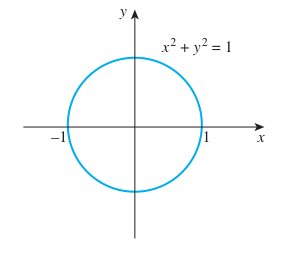
Example 1.3.2 The Circle Relation
Page 40
Define a relation C from \mathbb{R} to \mathbb{R} as follows: For any
(x, y) \in \mathbb{R} \times \mathbb{R}.
(x, y) \in C means that x^2 + y^2 = 1.
a. Is (1, 0) \in C? Is (0, 0) \in C? Is
\left(-\dfrac{1}{2}, \dfrac{\sqrt{3}}{2}\right) \in C? Is -2 C 0? Is 0 C
(-1)? Is 1 C 1?
b. What are the domain and co-domain of C?
c. Draw a graph for C by plotting the points of C in the Cartesian plane.
Solution
a. Is (1, 0) \in C? Is (0, 0) \in C? Is
\left(-\dfrac{1}{2}, \dfrac{\sqrt{3}}{2}\right) \in C? Is -2 C 0? Is 0 C
(-1)? Is 1 C 1?
Is (1, 0) \in C?
Yes, (1)^2 + (0)^2 = 1
Is (0, 0) \in C?
No, (0)^2 + (0)^2 = 0 \neq 1
Is \left(-\dfrac{1}{2}, \dfrac{\sqrt{3}}{2}\right) \in C?
Yes,
\left(-\frac{1}{2}\right)^2 + \left(\frac{\sqrt{3}}{2}\right)^2 = \frac{1}{4} + \frac{3}{4} = 1
Is -2 C 0?
No because (-2)^2 + (0)^2 = 4 \neq 1
Is 0 C (-1)?
Yes because (0)^2 + (-1)^2 = 1.
Is 1 C 1?
No, because (1)^2 + (1)^2 = 2 \neq 1.
b. What are the domain and co-domain of C?
The domain of C is \mathbb{R} and the co-domain of C is also \mathbb{R}.
c. Draw a graph for C by plotting the points of C in the Cartesian plane.
This is just the circle formula, so:
Example 1.3.3 Arrow Diagrams and Relations
Page 41
Let A = \{1, 2, 3\} and B = \{1, 2, 3\} and define relations S and T
from A to B as follows:
For every (x, y) \in A \times B,
(x, y) \in S means that x < y (S is a "less than" relation).
T = \{(2, 1), (2, 5)\}.
Draw arrow diagrams for S and T.
Solution
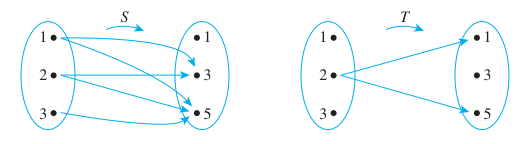
These example relations illustrate that it is possible to have several arrows
coming out of the same element of A pointing in different directions. Also, it
is quite possible to have an element of A that does not have an arrow coming
out of it.
Example 1.3.4 Functions and Relations on Finite Sets
Page 42
Let A = \{2, 4, 6\} and B = \{1, 3, 5\}. Which of the relations R, S,
and T defined below are functions from A to B?
a. R = \{(2, 5), (4, 1), (4, 3), (6, 5)\}
b. For every (x, y) \in A \times B, (x, y) \in S means that y = x + 1.
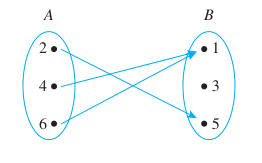
c. T is defined by the arrow diagram
Solution
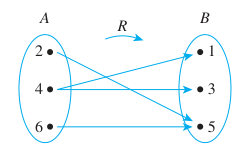
a. R = \{(2, 5), (4, 1), (4, 3), (6, 5)\}
R is not a function because it does not satisfy property (2). The ordered
pairs (4, 1) and (4, 3) have the same first element but different second
elements. You can see this graphically if you draw the arrow diagram for R.
There are two arrows coming out of 4: One point to 1 and the other points to 3.
b. For every (x, y) \in A \times B, (x, y) \in S means that y = x + 1.
S is not a function because it does not satisfy property (1). It is not true
that every element of A is the first element of an ordered pair in S. For
example 6 \in A but there is no y in B such that y = 6 + 1 = 7. You can
also see this graphically by drawing the arrow diagram for S.
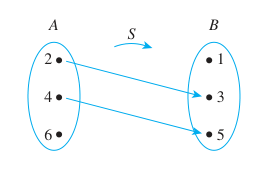
c. T is defined by the arrow diagram
T is a function: Each element in \{2, 4, 6\} is related to some element in
\{1, 3, 5\}, and no element in \{2, 4, 6\} is related to more than one
element in \{1, 3, 5\}. When these properties are stated in terms of the arrow
diagram, they become (1) there is an arrow coming out of each element of the
domain, and (2) no element of the domain has more than one arrow coming out of
it. So you can write T(2) = 5, T(4) = 1, T(6) = 1.
Example 1.3.5 Functions and Relations on Sets of Strings
Page 43
Let A = \{a, b\} and let S be the set of all strings over A.
a. Define a relation L from S to \mathbb{Z}^{\text{nonneg}} as follows:
For every string s in S and for every nonnegative integer n,
(s, n) \in L \text{ means that the length of } s \text{ is } n Observe that L is a function because every string in S has one and only one
length. Find L(abaaba) and L(bbb).
b. Define a relation C from S to S as follows: For all strings s and t
in S,
(s, t) \in C \text{ means that } t = as where as is the string obtained by appending a on the left of the characters
in s. (C is called concatenation by a on the left.) Observe that C
is a function because every string in S consists entirely of $a$'s and $b$'s
and adding an additional a on the left creates a new string that also consists
of $a$'s and $b$'s and thus is also in S. Find C(abaaba) and C(bbb).
Solution
a. Define a relation L from S to \mathbb{Z}^{\text{nonneg}} as follows:
For every string s in S and for every nonnegative integer n,
(s, n) \in L \text{ means that the length of } s \text{ is } n Observe that L is a function because every string in S has one and only one
length. Find L(abaaba) and L(bbb).
L(abaaba) = 6
L(bbb) = 3
b. Define a relation C from S to S as follows: For all strings s and t
in S,
(s, t) \in C \text{ means that } t = as where as is the string obtained by appending a on the left of the characters
in s. (C is called concatenation by a on the left.) Observe that C
is a function because every string in S consists entirely of $a$'s and $b$'s
and adding an additional a on the left creates a new string that also consists
of $a$'s and $b$'s and thus is also in S. Find C(abaaba) and C(bbb).
C(abaaba) = aabaaba
C(bbb) = abbb
Example 1.3.6 Functions Defined by Formulas
Page 44
The squaring function f from \mathbb{R} to \mathbb{R} is defined by
the formula f(x) = x^2 for every real number x. This means that no matter
what real number input is substituted for x, the output of f will be the
square of that number. The idea can be represented by writing
f(\Box) = \Box^2. In other words, f sends each real number x to x^2, or
symbolically, f: x \to x^2. Note that the variable x is a dummy variable;
any other symbol could replace it, as long as the replacement is made everywhere
the x appears.
The successor function g from \mathbb{Z} to \mathbb{Z} is defined by
the formula g(n) = n + 1. Thus, no matter what integer is substituted for n,
the output of g will be that number plus 1: g(\Box) = \Box + 1. In other
words, g sends each integer n to n + 1, or, symbolically,
g: n \to n + 1.
An example of a constant function is the function h from \mathbb{Q} to
\mathbb{Z} defined by the formula h(r) = 2 for all rational numbers r.
This function sends each rational number r to 2. In other words, no matter
what the input, the output is always 2: h(\Box) = 2 or h: r \to 2.
The functions f, g, and h, are represented by the function machines in
Figure 1.3.2 (see page 44).
A function is an entity in its own right. It can be thought of as a certain
relationship between sets or as an input/output machine that operates according
to a certain rule. This is the reason why a function is generally denoted by a
single symbol or string of symbols, such as f, G, or \log, or \sin.
A relation is a subset of a Cartesian product and a function is a special kind
of relation. Specifically, if f and g are functions from a set A to a set
B, then
f = \{(x, y) \in A \times B | y = f(x)\} \quad \text{ and } g(x) = \{(x, y) \in A \times B | y = g(x)\} It follows that
f \text{ equals } g, \quad \text{ written } f = g, \quad \text{ if, and only if, } f(x) = g(x) \text{ for all } x \text{ in } A Example 1.3.7 Equality of Functions
Page 44
Define functions f and g from \mathbb{R} to \mathbb{R} by the following
formulas:
f(x) = |x| \quad \text{ for every } x \in \mathbb{R} g(x) = \sqrt{x^2} \quad \text{ for every } x \in \mathbb{R} Does f = g?
Solution
Yes. Because the absolute value of any real number equals the square root of its
square, |x| = \sqrt{x^2} for all x \in \mathbb{R}. Hence f = g.
Example 1.4.1 Terminology
Consider the following graph:
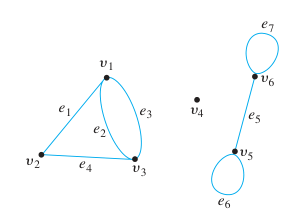
a. Write the vertex set and edge set, and give a table showing the edge-endpoint function.
b. Find all edges that are incident on v_1, all vertices that are adjacent to
v_1, all edges that are adjacent to e_1, all loops, all parallel edges, all
vertices that are adjacent to themselves, and all isolated vertices.
Solution
a.
\text{vertex set } = \{v_1, v_2, v_3, v_4, v_5, v_6\} \text{edge set } = \{e_1, e_2, e_3, e_4, e_5, e_6, e_7\} | Edge | Endpoints |
|---|---|
e_1 |
\{v_1, v_2\} |
e_2 |
\{v_1, v_3\} |
e_3 |
\{v_1, v_3\} |
e_4 |
\{v_2, v_3\} |
e_5 |
\{v_5, v_6\} |
e_6 |
\{v_5\} |
e_7 |
\{v_6\} |
b.
e_1, e_2, and e_3 are incident on v_1.
v_1 and v_3 are adjacent to v_1.
e_2, e_3, and e_4 are adjacent to e_1.
e_6 and e_7 are loops.
e_2 and e_3 are parallel.
v_5 and v_6 are adjacent to themselves.
v_4 is an isolated vertex.
Example 1.4.2 Drawing More Than One Picture for a Graph$adjacent
Page 49
Consider the graph specified as follows:
\text{vertex set } = \{v_1, v_2, v_3, v_4\} \text{edge set } = \{e_1, e_2, e_3, e_4\} edge-endpoint function:
| Edge | Endpoints |
|---|---|
e_1 |
\{v_1, v_3\} |
e_2 |
\{v_2, v_4\} |
e_3 |
\{v_2, v_4\} |
e_4 |
\{v_3\} |
Both drawings (a) and (b) shown below are pictorial representations of this graph (see Page 50).
Example 1.4.3 Labeling Drawings to Show They Represent the Same Graph
Page 50
Consider the two drawings shown in Figure 1.4.1. Label vertices and edges in such a way that both drawings represent the same graph.
(see page 50)
Solution
Imagine putting one end of a piece of string at the top vertex of Figure
1.4.1(a) (call this vertex v_1), then laying the string to the next adjacent
vertex on the lower right (call this vertex v_2), then laying it to the next
adjacent vertex on the upper left (v_3), and so forth, returning finally to
the top vertex v_1. Call the first edge e_1, the second edge e_2, and so
forth, as shown below.
(see page 50)
Now imagine picking up the piece of string, together with its labels, and repositioning it as follows:
(see page 50)
This is the same as Figure 1.4.1(b), so both drawings represent the graph with
vertex set \{v_1, v_2, v_3, v_4, v_5\}, edge set
\{e_1, e_2, e_3, e_4, e_5\}, and edge-endpoint function as follows:
| Edge | Endpoints |
|---|---|
e_1 |
\{v_1, v_2\} |
e_2 |
\{v_2, v_3\} |
e_3 |
\{v_3, v_4\} |
e_4 |
\{v_4, v_5\} |
e_5 |
\{v_5, v_1\} |
Example 1.4.4 Using a Graph to Represent a Network
Page 51
Telephone, electric power, gas pipeline, and air transport systems can all be represented by graphs, as can computer networks - from small local area networks to the global Internet system that connects millions of computers worldwide. Questions that arise in the design of such systems involve choosing connecting edges to minimize cost, optimize a certain type of service, and so forth. A typical network, called a hub-ad-spoke model, is shown below.
(see page 51)